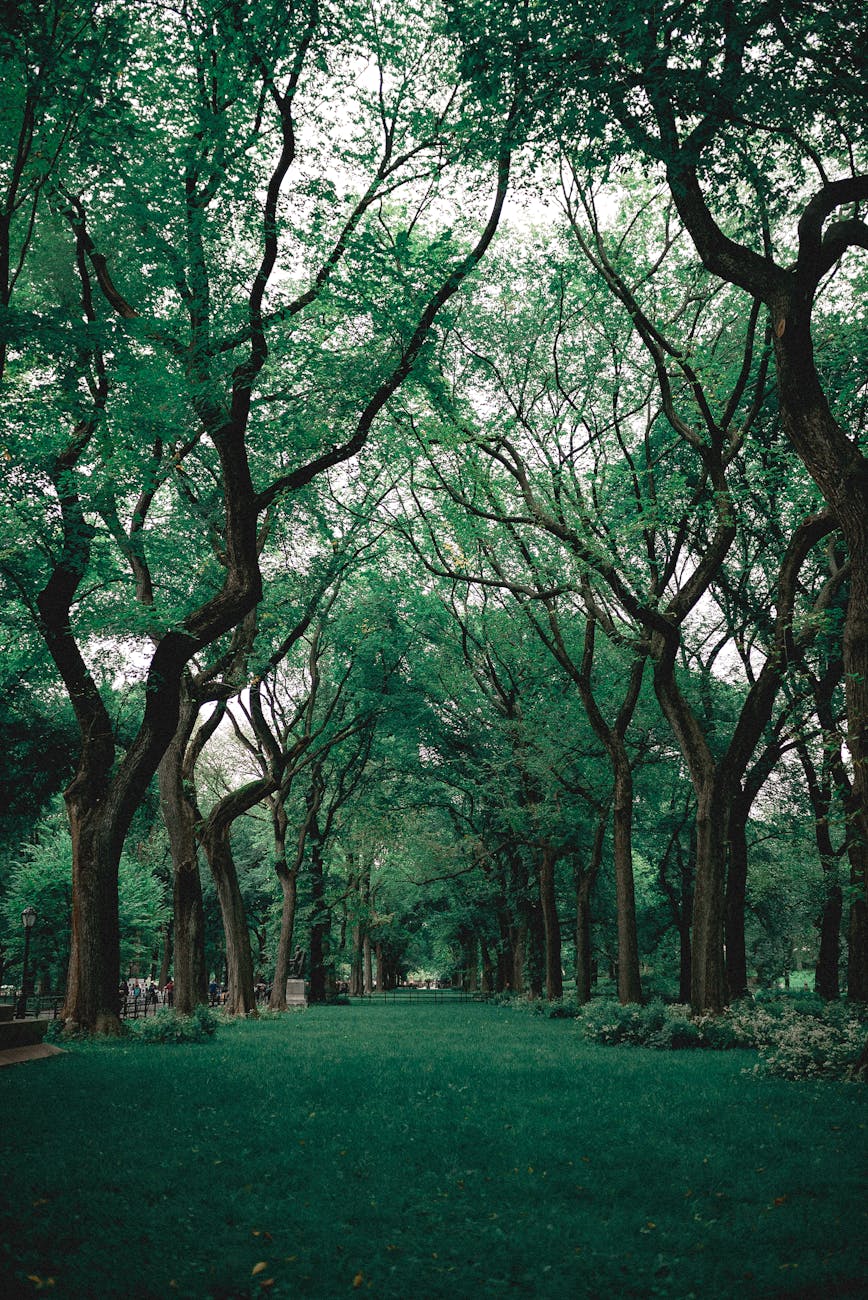
There are 59 national parks in the U.S. and 8,565 state parks and a lot of local and city parks. The map looks full:
So at first glance, you might wonder why access to nature is part of the Green New Deal. And once again, the answer is equal parts poverty and inequality.
Availability of good food is a problem for the poor in America. It is not a problem for middle class and richer Americans. However Americans of all incomes frequently make poor choices about food.
People have been talking about getting more nutritious food into inner city grocery stores for a generation, though, without much in the way of results. As poverty is just as real and just as pervasive in rural counties, a different approach is warranted.
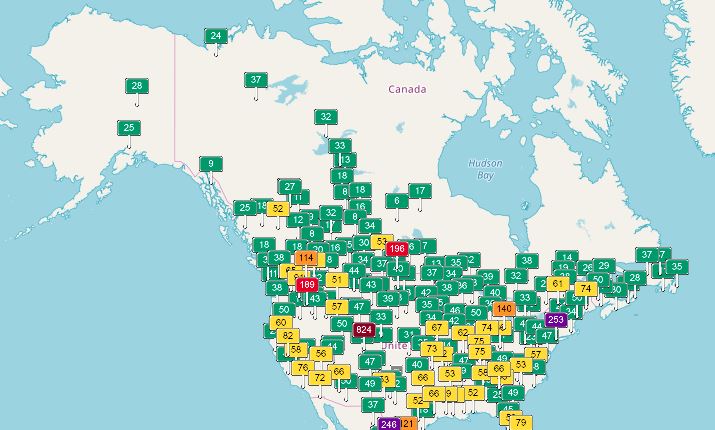
Green is good, yellow bad, red worse and purple just horrible. The picture changes from day to day, of course, but it’s clear that most Americans do enjoy clean air on most days of the year. But as with water pollution (and almost everything else that is bad in our land), air pollution is tougher on the poor and minorities. Not only are they exposed to more of it, they have fewer resources to deal with it.
Let’s talk about time. The Intergovernmental Panel on Climate Change (IPCC) wrote a special report on what will happen if global average temperature rises above 1.5C. They say that if we don’t get to zero emissions by 2050… well let’s let them say it and let’s start with the good-ish news:
In a nod to the environmental movement of the 70s, the Green New Deal has as a goal the delivery of clean water and air, healthy and affordable food and what I presume to mean access to nature.
Again, due to the length of the posts, we will have to deal with these one at a time. Today we’ll talk about clean water.
The Environmental Protection Agency is budgeted at about $8.9 billion a year at present. About 52% of that goes to improving water quality. About half that amount (45%) is in the form of grants to cities and states for specific projects. It could be more.
The Green New Deal as proposed calls for the provision of economic security for all Americans. And that’s all it says about it. Now we’re in favor of it in the abstract, but we need a definition in order to start on a road map.
The International Committee of the Red Cross defines economic security as “the ability of individuals, households or communities to cover their essential needs sustainably and with dignity. This can vary according to an individual’s physical needs, the environment and prevailing cultural standards. Food, basic shelter, clothing and hygiene qualify as essential needs, as does the related expenditure; the essential assets needed to earn a living, and the costs associated with health care and education also qualify.”
One element of the proposed Green New Deal is ‘affordable, safe and adequate housing.’ Our first post on this subject will concern those who have no homes.
“According to the U.S. Department of Housing and Urban Development (HUD), there were roughly 554,000 homeless people living somewhere in the United States on a given night last year. A total of 193,000 of those people were “unsheltered,” meaning that they were living on the streets and had no access to emergency shelters, transitional housing, or Safe Havens.”
There are at present 276 million registered vehicles in the United States. About 1 million of them are electric.
If the Green New Deal is to have any chance at achieving the Green part of the New Deal, almost all of this vast fleet of cars, pickups and SUVs will have to be electric by 2030. Is it possible? Yes. Will it be easy? No.
Let’s start with the glass half full. 2018 saw a phenomenal jump in the sales of electric cars–an 81% increase over 2017, which was also a banner year. Put another way, half of all the electric cars in America were sold in the past two years.
To get to 276 million electric vehicles, sales would have to grow at a phenomenal rate–but less than the 81% recorded in 2018. We’d ‘only’ need sales to grow at a 60% rate every year for 12 years. But things are not that simple, obviously.
Should the U.S. decide to pursue the Green New Deal, there are different approaches to take–but although one is probably optimal, we can expect to pursue two parallel tracks at different rates of speed.
One is brute force–we mandate (and probably finance) the environmental aspects of the GND, build out the needed solar and wind power generation, require a changeover to an electric fleet, and use regulation and legislation to push people into desired behaviors. We liken this to ancient Egyptians building the pyramids with slave labor, but then we’re harsh critics at times.
A British Thermal Unit (BTU) is the amount of energy needed to heat a pint of water from 39 to 40 degrees Fahrenheit. It’s about the amount of energy consumed by burning a wooden match.
We currently measure energy consumption by counting ‘quads.’ A quad is one quadrillion BTUs. It is about the amount of energy consumed by burning the contents of a train full of coal that has 100 tons of coal in each car. The train would stretch for 3,780 miles, from Albuquerque, New Mexico to Anchorage, Alaska.
A lot has been made in the media about the accelerated schedule of the Green New Deal–the sponsors of the Congressional resolution want us to get there in 12 years.
To us, what’s more interesting is the fusion of progressive economic and social goals with the environmental initiatives to get to zero emissions. And again, in the formative stages of all this, it’s easy to look at it as disconnected. We might even be permitted to speculate that a firm connection did not exist in the minds of the plan’s creators. But we think over the course of this blog’s existence that we will end up showing a very firm connection between the social, the economic and the environmental elements.
Progressives began labeling healthcare a human right about a decade or so before the Green New Deal. Old school opponents were quick to object–how can infrastructure and services painstakingly built up over centuries at great cost to companies and individuals be re-characterized as providing something (healthcare) that their customers (patients) all of a sudden have a right to?
It is our intention to show how to get as close as possible to fulfilling the aspirations of those hoping to reduce or eliminate our contributions to climate change.
It is also our hope to outline what individuals, communities, organizations and countries can do to help. It may be our small conceit to have one tip in every blog post.
Although the Green New Deal was launched as an American initiative, human contributions to climate change are of course global. We will try and talk to both the American situation and the global condition.

 The Green New Deal--How To Get There